




Key Takeaways
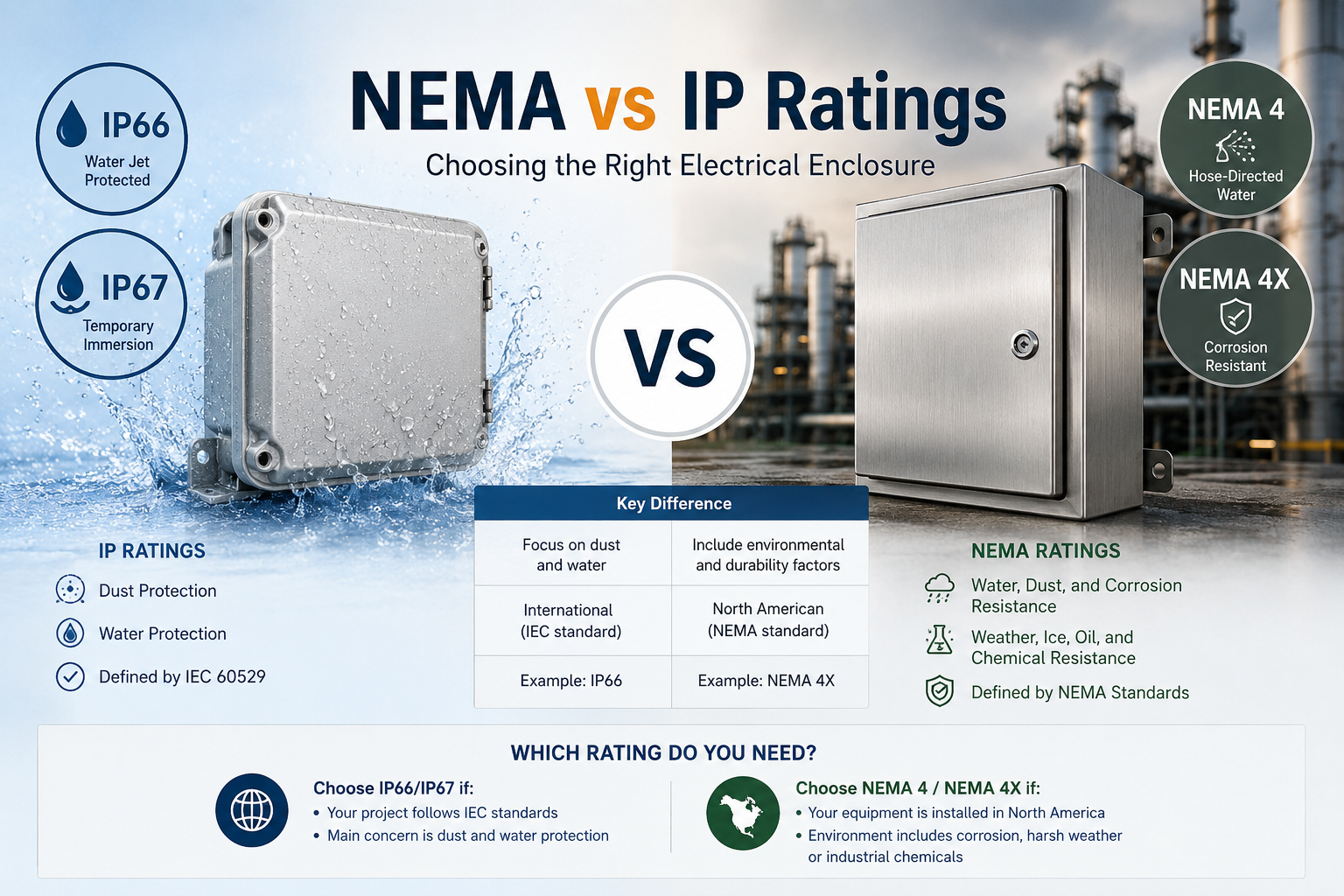
- IP ratings measure protection against dust and water.
- NEMA ratings include environmental protection and enclosure durability.
- IP66 is not always equivalent to NEMA 4 or NEMA 4X.
- Choosing the right enclosure depends on the application and installation environment.
Why Protection Ratings Matter
If you're selecting an electrical enclosure, you've probably seen terms like IP66, IP67, NEMA 4, или NEMA 4X.
Many people assume these ratings are interchangeable, but they're actually based on different standards and evaluate different types of protection.
Understanding the difference helps you choose the right enclosure for your project while avoiding unnecessary costs.
What Is an IP Rating?
IP (Ingress Protection) ratings are defined by the IEC 60529 standard.
An IP rating uses two numbers:
- First digit: protection against solid objects and dust
- Second digit: protection against water
For example:
IP ratings mainly focus on preventing dust and water from entering the enclosure.
What Is a NEMA Rating?
NEMA ratings are developed by the National Electrical Manufacturers Association in the United States.
Unlike IP ratings, NEMA standards consider additional environmental factors such as:
- Corrosion resistance
- Outdoor weather exposure
- Ice formation
- Oil and coolant resistance
- Mechanical durability
For example:
| NEMA Rating | Typical Protection |
|---|---|
| NEMA 1 | Indoor use |
| NEMA 3R | Outdoor rain protection |
| NEMA 4 | Hose-directed water and dust |
| NEMA 4X | Same as NEMA 4 with corrosion resistance |
| NEMA 12 | Indoor dust and oil resistance |
Is IP66 the Same as NEMA 4X?
Not exactly.
Although many manufacturers market IP66 enclosures as comparable to NEMA 4, the standards are different.
Generally speaking:
- IP66 is roughly comparable to NEMA 4
- IP66 does not automatically meet NEMA 4X
- NEMA 4X requires additional corrosion resistance testing
If your enclosure will be installed in coastal areas, food processing plants, or chemical facilities, NEMA 4X is often the better choice.
Which Rating Should You Choose?
The answer depends on where the enclosure will be used.
Choose IP66/IP67 if:
- Your project follows IEC standards.
- The main concern is protection from dust and water.
Choose NEMA 4 or NEMA 4X if:
- Your equipment is installed in North America.
- The environment includes corrosion, harsh weather, or industrial chemicals.
Many industrial enclosures are designed to meet both standards, making them suitable for global applications.
Типичные области применения
Different industries often require different protection levels.
- Factory automation
- Системы возобновляемой энергетики
- EV charging equipment
- Телекоммуникации
- Сооружения по очистке воды
- Панели управления для наружной установки
- Морские экосистемы
Selecting the correct rating improves equipment reliability and reduces maintenance costs over time.
Final Thoughts
Neither IP nor NEMA ratings are "better" than the other—they simply evaluate enclosure performance from different perspectives.
When selecting an enclosure, always consider the installation environment, industry standards, and long-term operating conditions rather than choosing based on a rating alone.
If you're unsure which protection level fits your project, consulting your enclosure manufacturer early in the design process can help avoid costly redesigns later.
Author: Tim Warner
Contact with us: mia@hofengfab.com