




In the industrial automation and electrical engineering worlds, we spend a massive amount of time calculating thermal loads, configuring PLCs, and routing wiring harnesses. But out in the field, all that expensive internal components mean absolutely nothing if the metal box protecting them fails.
As a sheet metal manufacturing engineer, I see a lot of off-the-shelf wall mount enclosures deployed in environments they have no business being in. When an enclosure fails—whether it’s due to water ingress, structural sagging, or accelerated corrosion—it’s rarely the fault of the environment itself. It’s almost always a failure in material selection, bending precision, or welding execution during the fabrication phase.
If you are a procurement manager or a systems engineer sourcing custom wall-mounted cabinets for industrial or outdoor infrastructure, let’s skip the marketing buzzwords. Let’s look at the actual manufacturing physics that dictate whether your enclosure will protect your electronics for 20 years or rust out in two.
1. Structural Rigidity: Preventing the "Door Sag" Phenomenon
One of the most common field failures with larger wall mount electrical enclosures isn’t electrical—it’s mechanical. Over time, the door begins to sag, meaning the continuous polyurethane gasket no longer aligns perfectly with the sealing lip. Suddenly, your IP65 rating drops to zero, and moisture creeps in.
Why does this happen? It comes down to sheet metal gauge and reinforcement:
-
The Material Gauge: Cheap enclosures use thin 1.2mm carbon steel for the entire body to save costs. For industrial environments, the enclosure body should be fabricated from at least 1.5mm to 2.0mm heavy-gauge cold-rolled steel or stainless steel, depending on the volume.
-
Door Stiffeners: Any wall-mount door wider or taller than 400mm needs integrated, welded stiffener profiles on the inside. These profiles prevent the metal from flexing when field technicians mount heavy human-machine interfaces (HMIs) or display screens directly onto the door face.
2. The Physics of a True IP65/IP66 Seal: Bending and Gaskets
When a data sheet claims an enclosure is "waterproof," you need to look closely at how the metal is folded and sealed. A high-quality wall mount box relies on a critical design feature called a knife-edge flange (or a formed rain channel).
   [ Door Gasket ] --->  [  ]
                           ||
   [ Knife-Edge ]  --->  _/\_  <--- Diverts water away from the interior
                        |    |
                        |    |
Instead of a flat mating surface, the enclosure opening is bent outward and upward to create a literal gutter. When water flows down the wall, this knife-edge diverts the liquid away from the seal completely.
Furthermore, you have to look at the gasket technology. Strips of adhesive rubber foam cut and pasted by hand will eventually lift and leak at the corner joints. Modern industrial enclosures require a poured-in-place polyurethane foam gasket. This chemical compound is applied by a robotic CNC dispensing machine directly into the door channel, creating a continuous, seamless, and high-memory seal that doesn't degrade over thousands of open-close cycles.
3. Material Selection: Cold-Rolled vs. Stainless Steel
I always tell clients: don't just buy the cheapest metal; buy the one that matches your atmospheric reality.
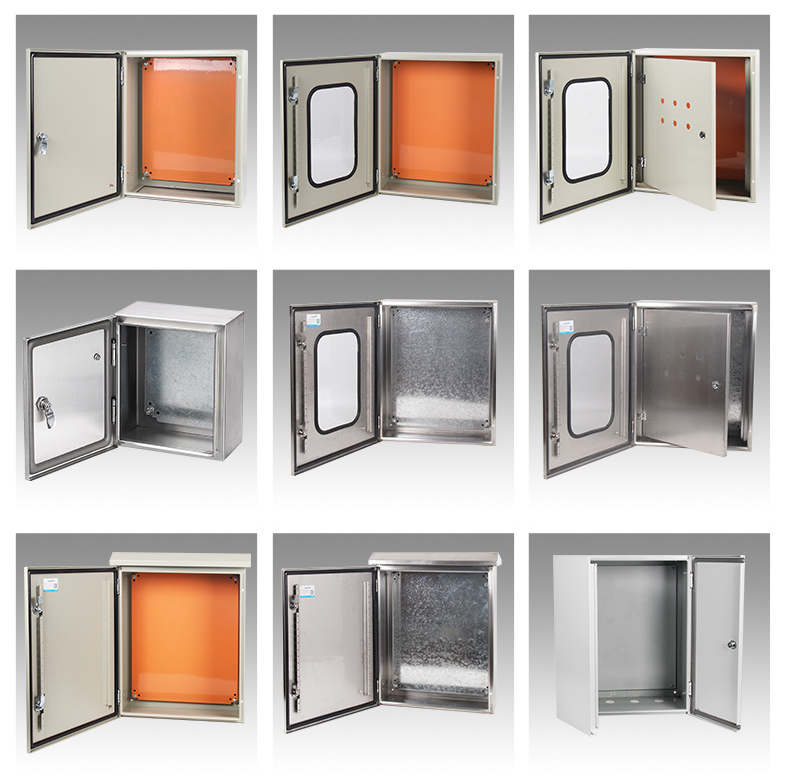
Cold-Rolled Steel (SPCC) with Powder Coating
-
Best For: Factory floors, indoor automation lines, and standard warehouse environments.
-
The Technical Secret: Raw steel rusts instantly. The secret to longevity is the pretreatment and coating process. Before receiving an electrostatic powder coat (typically RAL 7035), the metal must undergo a multi-stage chemical washing and phosphating process to ensure the paint creates a molecular bond with the steel. If the paint chips, a proper phosphate undercoat stops rust from creeping under the remaining finish.
Stainless Steel (Grade 304 or 316)
-
Best For: Food processing plants (requiring harsh chemical washdowns), water treatment facilities, and coastal marine installations.
-
The Technical Secret: Grade 316 stainless steel contains molybdenum, which dramatically increases resistance to chlorides (like sea salt and heavy detergents). If your enclosure is going near the ocean or a chemical processing line, carbon steel is out of the question—stainless is a strict engineering requirement.

4. Mounting and Heat Dissipation Considerations
When you mount a heavy enclosure to a concrete wall or a structural steel beam, the mounting brackets take a lot of dynamic stress. Look for enclosures that utilize external mounting ears or internal heavy-duty blind nuts (PEM nuts) pressed directly into the rear panel. You never want to drill your own mounting holes straight through the back sheet, as this completely compromises the watertight rating.
Additionally, remember that sealing a box up tightly traps heat. If your internal drives, power supplies, or transformers are generating significant wattage ($W$), you must calculate the thermal dissipation footprint. A fully sealed steel box can only radiate a limited amount of heat through its surface area. If your calculations show a thermal spike, you'll need to specify factory-laser-cut cutouts for ventilation louvers, filter fans, or active cooling units.
The Fabrication Bottom Line
You can buy the most advanced, high-end automation components in the world, but if you house them in a flimsy, poorly welded enclosure, you are asking for trouble. Precision tolerances matter. A fraction of a millimeter of error during CNC punching, laser cutting, or brake press bending translates into a misaligned door, a ruined seal, and a field failure down the road.
If you are currently designing infrastructure or need custom-engineered, ruggedized wall mount enclosures built to precise 3D CAD tolerances, let’s talk. At Hofengfab, we live and breathe precision sheet metal fabrication, heavy-duty welding, and premium industrial finishings. We build enclosures to survive the real world.
👉 문의하기 이제 귀사의 배터리 케이스 요구 사항에 대해 논의해 보겠습니다.