




주요 내용
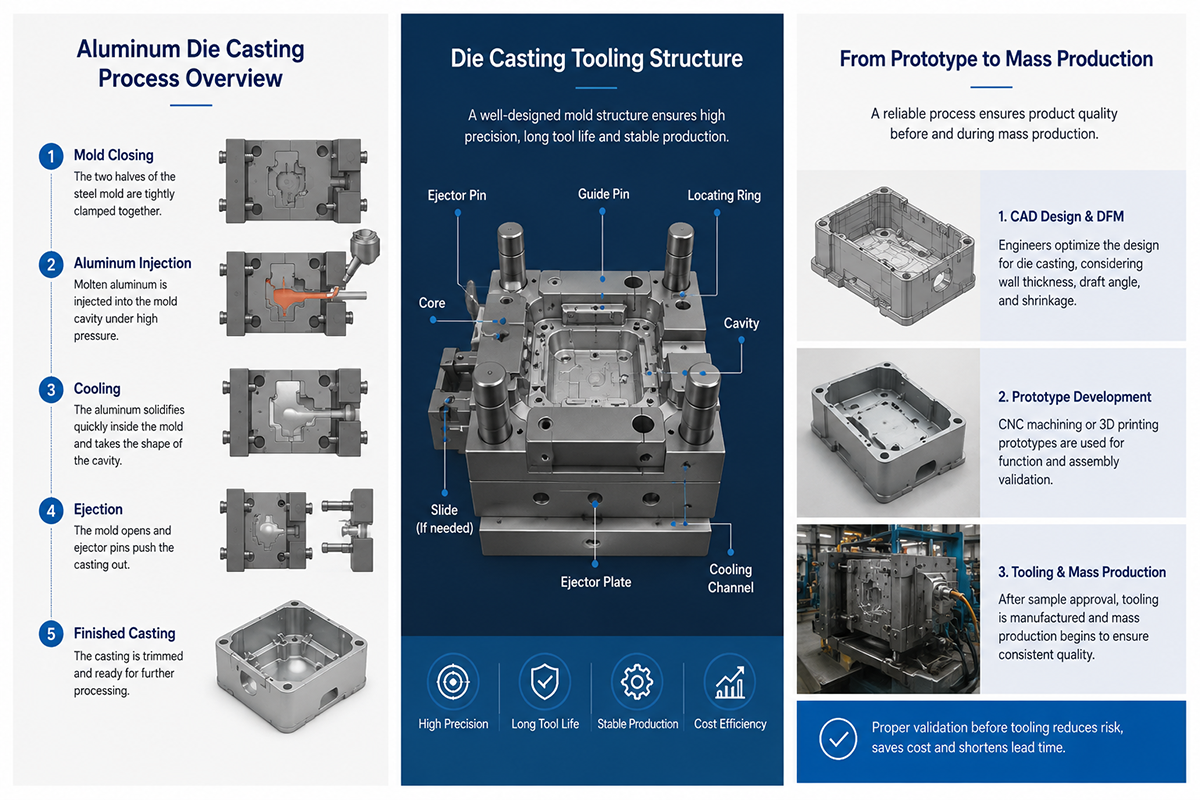
- Aluminum die casting requires steel tooling (molds) to ensure dimensional accuracy and repeatability.
- Tooling is a one-time investment that determines product quality and production efficiency.
- Prototype validation is usually required before final mold approval.
- Tool design affects surface finish, tolerance, and production cost.
- CNC machining and 3D printing are often used before tooling to reduce development risk.
What Is Aluminum Die Casting Tooling?
In aluminum die casting, tooling refers to the steel mold (die) used to shape molten aluminum under high pressure.
Unlike CNC machining or 3D printing, die casting cannot be performed without a dedicated mold. The tooling defines:
- Product geometry
- Internal structure
- 벽 두께
- Surface texture
- Dimensional tolerance
Because molten aluminum is injected at high pressure, the mold must be made from hardened tool steel capable of withstanding extreme thermal and mechanical stress.
Why Tooling Is Required Before Mass Production
The main reason die casting requires tooling is repeatability.
Once the mold is created, every cycle produces identical parts. This is essential for industrial components such as:
- 전기 인클로저
- Junction box housings
- Control cabinets
- Outdoor waterproof housings
- Industrial connectors and covers
Without tooling, it is impossible to guarantee consistency across thousands or millions of units.
Tooling ensures:
- Dimensional stability
- Structural repeatability
- Surface consistency
- High-volume production efficiency
How Aluminum Die Casting Tooling Works
The tooling process typically involves the following steps:
1. Product Design Review (DFM Analysis)
Before manufacturing the mold, engineers evaluate the design for manufacturability:
- Wall thickness uniformity
- Draft angles
- Rib structure
- Shrinkage compensation
- Ejection system feasibility
This stage is critical because design errors become very expensive once the mold is built.
2. Mold Design
The mold is designed using CAD software, including:
- Core and cavity layout
- Cooling channels
- Ejection pins
- Gate and runner system
- Venting structure
A well-designed mold directly affects product quality and cycle time.
3. Tool Steel Selection
Tooling is typically made from hardened steel such as:
- H13
- SKD61
These materials are selected because they can withstand:
- High injection pressure
- Repeated thermal cycling
- Long production life cycles
4. CNC 가공 of Mold
The mold is manufactured using high-precision CNC machining centers. This ensures:
- Tight tolerances
- Smooth cavity surfaces
- Accurate alignment between mold halves

5. Heat Treatment and Surface Hardening
After machining, the mold is heat-treated to improve hardness and wear resistance.
This step determines the lifespan of the tooling.
6. Trial Production (T1 Sample)
The first mold trial is used to evaluate:
- Dimensional accuracy
- Surface defects
- Shrinkage behavior
- Filling performance
Adjustments are often required before mass production approval.
Tooling Cost vs Production Value
One of the most misunderstood aspects of die casting is tooling cost.
Tooling is expensive, but it is a long-term investment.
Why tooling cost is justified:
- Enables mass production at low unit cost
- Ensures consistent quality
- Reduces long-term manufacturing errors
- Supports high-volume automation
In most cases, the more complex the product, the higher the tooling cost—but the lower the unit cost over time.
Prototype Before Tooling: Why It Matters
Before investing in tooling, manufacturers often validate the design using:
- 3D 프린팅
- CNC 가공
- Rapid aluminum prototypes
This helps identify:
- Structural weaknesses
- Assembly issues
- Fit and tolerance problems
At Hofeng, we often recommend a prototype-first approach to reduce tooling risk.
Die Casting vs CNC 가공
Many customers compare die casting with CNC machining.
CNC Machining:
- No tooling required
- Ideal for low-volume production
- Higher unit cost
Die Casting:
- Requires tooling
- Ideal for high-volume production
- Lower unit cost per part
The decision depends on production volume and lifecycle cost.
Applications of Aluminum Die Casting
Aluminum die casting is widely used in:
- 전기 인클로저
- Waterproof junction boxes
- Industrial control housings
- Outdoor communication equipment
- EV charging systems
- Solar energy systems
- Marine equipment
These industries require durability, precision, and environmental resistance.
Common Mistakes in Tooling Design
Engineers often encounter issues such as:
- Insufficient draft angles
- Uneven wall thickness
- Poor venting design
- Overly complex geometry
- Ignoring shrinkage compensation
These mistakes can lead to:
- Mold failure
- Poor surface finish
- Dimensional inaccuracy
- High scrap rates
How Hofengfab Supports Aluminum Casting Manufacturers
~에서 Hofengfab, we support customers from concept to mass production:
- DFM engineering review
- Prototype validation (CNC / 3D printing)
- Tooling design and development
- Trial production (T1–T3)
- Mass production manufacturing
- Surface finishing (powder coating, anodizing, painting)
Our goal is to reduce development risk while ensuring manufacturability from the beginning.

결론
Aluminum die casting tooling is the foundation of high-volume manufacturing. Although it requires an upfront investment, it ensures consistency, precision, and cost efficiency in long-term production.
Understanding tooling design, prototype validation, and production workflow is essential for any engineering project involving aluminum enclosures or industrial components.
For complex enclosure projects, a well-planned tooling strategy can significantly reduce cost and accelerate time to market.
Frequently Asked Questions
1. Why is tooling required for aluminum die casting?
Tooling is required to form molten aluminum into precise shapes under high pressure, ensuring repeatability in mass production.
2. How long does die casting tooling last?
Depending on material and usage, a mold can last from tens of thousands to hundreds of thousands of cycles.
3. Can I skip tooling for small production volumes?
Yes, CNC machining or rapid prototyping can be used for low-volume production before investing in tooling.
4. What materials are used for die casting molds?
Common tool steels include H13 and SKD61 due to their heat resistance and durability.
5. What is the difference between prototype and tooling production?
Prototype production validates design feasibility, while tooling enables full-scale mass production with consistent quality.
Author: Mike Turker
이메일: mia@hofengfab.com