




An Engineer’s Practical Approach to Waterproof and Heat Dissipation
Designing an enclosure for industrial electronics is rarely just about mechanical protection. When a PCB includes power components and must operate in a sealed IP66 または IP67 enclosure, thermal management becomes one of the key design challenges.
Why Passive Cooling Is Preferred in IP66/IP67 Designs
IP66 and IP67 enclosures are designed to withstand:
-
Dust ingress
-
High-pressure water jets or temporary immersion
-
Harsh industrial environments
In such conditions, airflow-based cooling introduces risks:
-
Seal degradation over time
-
Contamination from dust, oil mist, or moisture
-
Increased failure points due to fans and vents
For these reasons, experienced engineers generally avoid active airflow and instead rely on passive conduction cooling as the primary thermal strategy.
Enclosure as a Thermal Component, Not Just a Shell
In passive cooling designs, the enclosure itself becomes part of the thermal path.
A typical heat transfer path looks like this:
-
Heat generated by power components
-
Heat conducted through PCB copper and thermal vias
-
Heat transferred to the enclosure base via thermal pads or grease
-
Heat dissipated from the enclosure surface to ambient air
This approach minimizes complexity while maintaining full environmental protection.
Material Selection: Extruded Aluminum 6063-T5
Extruded aluminum alloy 6063-T5 is commonly used for industrial enclosures due to:
-
Good thermal conductivity
-
Excellent extrusion capability
-
Stable machining and anodizing properties
Its extrusion flexibility also allows integrated cooling fins to be designed directly into the enclosure profile.
Improving Heat Dissipation with Cooling Fins
For sealed enclosures, thermal performance can be effectively improved by:
-
Increasing cooling fin height
-
Enlarging total fin surface area
This typically requires modifications to the enclosure structure, especially the extrusion profile. However, it is one of the most reliable ways to enhance heat dissipation without compromising IP protection.
Well-designed fins increase surface area while keeping the enclosure fully sealed, making them ideal for long-term industrial operation.
Waterproof Structure: Screw Position and Sealing Design
To achieve reliable IP66/IP67 sealing, enclosure structure is just as important as material choice.
Common best practices include:
-
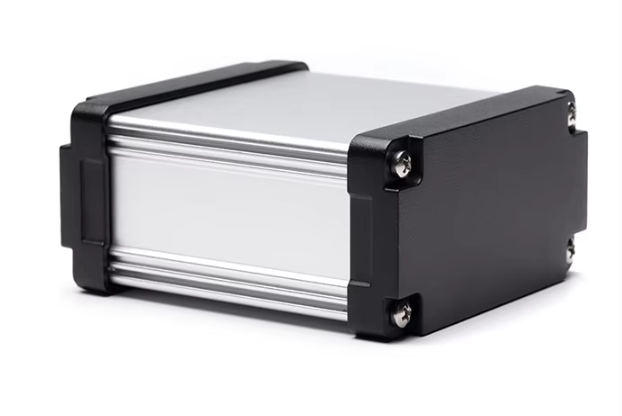
Placing all fastening screws on the outer side エンクロージャーの
-
Designing side panels with dedicated grooves for O-rings or sealing gaskets
-
Avoiding through-holes that could compromise the sealing surface
This type of structure is widely used in industrial electronics and provides consistent waterproof performance when properly assembled.


Manufacturing Considerations: Prototype vs. Mass Production
Manufacturing methods should match project volume and stage:
-
Small quantities / prototyping:
CNC-machined aluminum side panels are more flexible and cost-effective. -
Large volumes:
Plastic injection molding for side panels is recommended to reduce unit cost and improve consistency.
These choices allow projects to scale smoothly from prototype to mass production.
Design Support and Engineering Collaboration
In many cases, customers already have a basic concept or rough drawings. From an engineering standpoint, these do not need to be fully detailed.
As long as the general structure is defined:
Hofengfab engineers can optimize sealing details
Improve thermal paths
Adjust extrusion profiles for manufacturability
This collaborative approach reduces development time and avoids unnecessary redesign costs.
結論
For industrial PCBs requiring waterproof protection and stable thermal performance, passive conduction cooling in a sealed aluminum enclosure remains the most reliable solution.
By combining:
Extruded aluminum enclosures
Optimized cooling fin design
Proper sealing structures
Hofengfab engineers can achieve long-term reliability, true IP66/IP67 protection, and predictable thermal behavior — without the risks associated with active ventilation.