FDM 3d printing service
تتيح هذه التقنية إنشاء نماذج أولية وإنتاج قطع الغيار بسرعة، حيث يمكن إنتاج القطع في غضون 10 أيام فقط، مع إجراء فحص 100% لكل قطعة
نحن حائزون على شهادة ISO 9001، ونقدم جودة من الدرجة الأولى في كل دفعة
- لا يوجد حد أدنى لكمية الطلب
- صُنعت بسرعة في غضون بضع الأيام
- النماذج الأولية السريعة وعمليات الإنتاج الكاملة
- تتوفر أكثر من 30 نوعًا من المواد المعدنية والبلاستيكية
what is FDM 3d printing
Before we describe the working principle of FDM 3D printer, we can imagine such a scene: first, you hold a heated toothpaste, which is liquid in the toothpaste box, but will solidify immediately as soon as you squeeze it out; then you hold the toothpaste upside down and squeeze it onto the table, moving horizontally while squeezing, just like writing calligraphy; after you finish the work on the first layer of the table, lift the toothpaste up a little bit, and then continue to squeeze the toothpaste onto the second plane. At this time, the squeezed toothpaste will stick to the previous toothpaste, and the first squeezed toothpaste will solidify to form a support for the subsequent squeezed toothpaste; finally, you keep repeating the above process until you squeeze out the shape you want. This is actually the basic idea of FDM, and it is also the working principle of the new 3D printing pen on the market.
Fused Deposition Modeling (FDM), alternatively known as fused deposition or filament deposition, is a 3D printing technique that primarily utilizes filamentary hot-melt materials as its raw material base. This process involves heating and melting these materials to a liquid state, allowing them to be extruded through a fine nozzle. As the liquefied material is sprayed out, it is deposited onto a panel or onto the previously solidified layer.
As the temperature of the deposited material drops below its melting point, it begins to solidify, gradually building up the desired object through the layer-by-layer accumulation of material. This approach allows for high precision and control over the final product, making it suitable for various applications.
FDM thermoplastics exhibit properties that are ideal for applications that require precise tolerances, durability, and stability across different environments. These materials often include thermoplastics that are also used in traditional manufacturing processes, such as injection molding, ensuring compatibility and reliability.
The versatility and precision of FDM make it a popular choice for prototyping, small-batch production, and even certain large-scale manufacturing tasks. Its ability to use a wide range of thermoplastic materials further broadens its application potential, allowing for the creation of complex geometries and structures that may be difficult to achieve through other manufacturing methods.
The main advantages of FDM technology
FDM 3D printing SERVICE
(1) The construction principle and operation of hot melt extrusion parts are relatively simple, maintenance operation is relatively convenient, and the system operation is relatively safe.
(2) The manufacturing cost and maintenance cost are relatively low, and the price is very competitive.
(3) There is an open source project to support it, and relevant information is relatively easy to obtain.
(4) The printing process is relatively simple, the process flow is short, and direct printing is required without scrapers and other processes.
(5) The complexity of the model does not affect the printing process, and it can be used to make objects with complex cavities and holes.
(6) The raw materials do not undergo chemical changes during the printing process, and the warping deformation of the printed objects is relatively small.
(7) The utilization rate of raw materials is high, and the material shelf life is long.(8) The printed wax model can be combined with traditional techniques and used directly in investment casting.
FDM 3D printing technology features
Among 3D printing devices with different technologies, the equipment manufactured using FDM technology generally has the characteristics of simple mechanical structure and easy design, and the manufacturing cost, maintenance cost and material cost are also the lowest among various technologies. Therefore, all the current home desktop 3D printers use this technology.
The key technology of FDM process lies in the hot melt nozzle, which needs to be stably and accurately controlled to ensure that the raw materials can maintain a certain strength and have good bonding performance when they are extruded from the nozzle. In addition, the raw materials for printing are also very important. Their purity and uniformity of the material will affect the final printing effect.
A major advantage of FDM technology is that it is simple to manufacture and has low cost. For desktop 3D printers, there will be no control components added to the discharge part, making it difficult to accurately control the discharge shape and molding effect. At the same time, temperature has a great impact on the FDM molding effect, and desktop FDM 3D printers usually lack constant temperature equipment. This leads to the finished product accuracy of FDM-based desktop 3D printers usually being 0.3~0.1mm. Only a few high-end models can support layer thickness below 0.1mm, but due to the influence of temperature control, the final printing effect is still not stable enough. In addition, when most FDM 3D printers are printing, the edge of each layer is prone to a "step effect" caused by layered deposition, which makes it difficult to achieve a WYSIWYG 3D printing effect. Therefore, FDM equipment is rarely used when high precision is required.
The main disadvantages of FDM technology
(1) There are very obvious step stripes on the surface of the molded part, and the overall accuracy is low.
(2) Due to material and process limitations, the force strength of the printed object is low, and support structures must be added for special structures.
(3) The material strength along the Z-axis direction of the molded part is relatively weak, and it is not suitable for printing large objects.
(4) It is necessary to print one by one according to the cross-sectional shape, and due to the influence of inertia, the nozzle cannot move quickly, resulting in a slow printing process and a long printing time.

قدراتنا التصنيعية الأخرى
نحن متخصصون في الطباعة ثلاثية الأبعاد، والتصنيع باستخدام الحاسب الآلي (CNC)، والصب بالفراغ، والقولبة بالحقن، وتصنيع الصفائح المعدنية، ونقدم مجموعة واسعة من المواد والتشطيبات السطحية.

التصنيع باستخدام الحاسب الآلي (CNC)
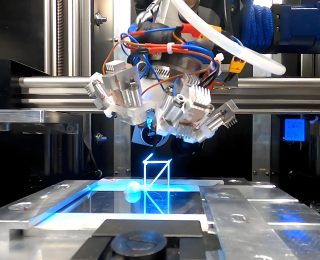
لدينا مركز تصنيع مركب يجمع بين عمليات الطحن والخراطة، وآلات طحن قياسية ثلاثية المحاور، وآلات طحن خماسية المحاور متواصلة، وآلات طحن ثلاثية + ثنائية المحاور، بالإضافة إلى عمليات الحفر والمعالجة اللاحقة باستخدام أكثر من 50 نوعًا مختلفًا من المعادن والبلاستيك، متوفرة بأكثر من 15 نوعًا من التشطيبات السطحية. تتراوح التفاوتات المسموح بها حتى ±0.0000394 بوصة (0.001 مم)
تصنيع الصفائح المعدنية
HOFeng’s equipped with robot CO2 welding, robot polishing, robot laser welding, laser platform welding, laser cutting machine, handheld laser welding, CNC punch machine, bending machine, automatic deburring machine to improve the speed and ability to cope with mass production applications.

خدمات صب اليوريثان
نقدم خدمات النماذج الأولية السريعة وإنتاج القطع، حيث يمكن إنتاج القطع في غضون 10 أيام فقط، مع إجراء فحص 100% لكل قطعة. ونحن حاصلون على شهادة ISO 9001، مما يضمن جودة عالية في كل دفعة. نحن خبراء مواد البولي يوريثان في مجال تطوير منتجاتكم