


A junction box is often described simply as a box that protects electrical connections.
That definition is correct, but it leaves out the part that matters most when you're actually designing or purchasing one.
In a real project, a junction box has to work with cables, terminals, connectors, mounting points, sealing components and the surrounding environment. A box that looks large enough on a drawing can still become difficult to wire, difficult to seal or difficult to manufacture.
After reviewing custom electrical enclosure requirements, we've found that one of the most common mistakes is choosing the enclosure first and figuring out the internal connections afterward.
We recommend doing the opposite: start with the connection, then design the box around it.
What Is a Junction Box?
A junction box is an enclosure used to contain and protect electrical connections, cable junctions, terminals or wiring components.
Depending on the application, it may contain simple wire connections or a more organized assembly with terminal blocks, DIN rail components, fuses, connectors or other electrical parts.
The important point is that the junction box is not an isolated component.
Its performance depends on the complete assembly:
Enclosure + cover + gasket + cable entries + terminals + fasteners + installation
This is why two junction boxes with similar external dimensions can behave very differently in a real installation.
One may provide plenty of room for wiring and maintenance.
The other may technically fit the components but leave no practical room for cable routing.
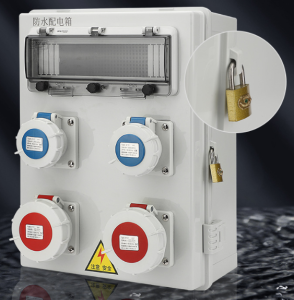
What Does a Junction Box Actually Do?
The basic function is to provide a defined and protected location for electrical connections.
But in engineering applications, we normally look at several functions at the same time.
Protect the connections
The enclosure creates a physical barrier around electrical connections and helps protect them from the surrounding environment.
Keep wiring organized
Instead of having multiple connections distributed randomly throughout an installation, the junction box creates a defined connection point.
Provide access for maintenance
A properly designed junction box should allow technicians to inspect, test or modify the connections without unnecessarily disturbing the rest of the installation.
Control environmental exposure
Depending on its construction and rating, the enclosure can help protect internal connections against dust, moisture and water exposure.
This last point is where many enclosure specifications become misleading.
A junction box does not become "waterproof" simply because the box itself has a gasket.
The complete installed system matters.
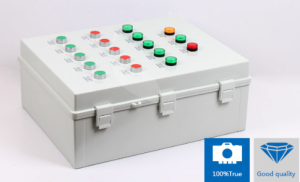
Junction Box vs. Electrical Enclosure: Are They the Same?
Not exactly.
Electrical enclosure is the broader term.
An electrical enclosure can house:
- PLCs
- Circuit breakers
- Power supplies
- Relays
- Controllers
- PCBs
- Switchgear
- Terminal blocks
- Communication equipment
A junction box usually has a more specific role around connections, junctions and cable termination.
However, the distinction isn't always strict.
A larger custom junction box may contain terminal blocks, fuses, relays or other components.
So when a customer tells us: "We need a junction box."
the product name alone doesn't tell us enough.
Our next question is usually: "What are you putting inside it?"
That answer often has more influence on the enclosure design than the word "junction box" itself.
The First Thing We Check: What's Inside?
This is one of the biggest differences between selecting a standard enclosure and engineering a custom one.
Suppose someone requests a:
200 × 150 × 100 mm junction box
On paper, the dimensions seem clear.
But we still don't know:
- How many terminals are inside?
- How large are the terminals?
- Is DIN rail required?
- How many cables enter?
- Where do the cables enter?
- What is the cable diameter?
- How much bending space is required?
- Does the assembly need internal mounting bosses?
- Can a technician reach the terminals after installation?
This is why we don't treat the enclosure as an empty rectangular volume.
We look at the actual assembly inside it.
Why Usable Space Matters More Than Nominal Volume
This is a lesson that becomes particularly obvious with shallow junction boxes.
Consider two theoretical designs:
100 × 100 × 60 mm and 120 × 100 × 50 mm
The second enclosure has a different external shape, but simply comparing the nominal volume doesn't tell you which one is better.
If the cable entries are positioned poorly, the terminal block is too close to the wall, or the cable needs to make a tight bend after entering the gland, the enclosure with the larger nominal volume may actually be harder to assemble.
That's why our engineering review focuses on:
usable space, not just nominal volume.
We want to know whether the components can be:
- Installed
- Wired
- Closed
- Tested
- Serviced
without forcing everything into the available space.
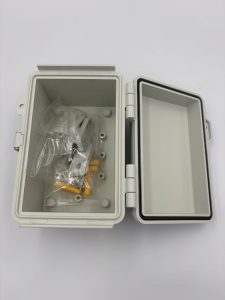
Cable Bending Space Is Easy to Forget
Customers usually remember to specify the cable gland.
They don't always specify what happens to the cable after it enters the enclosure.
This matters.
A cable doesn't stop at the gland.
It needs to travel to a terminal, connector or other component, and that may require a certain bending radius depending on the cable construction and installation requirements.
This is particularly important when:
- The enclosure is shallow
- Cable diameters are large
- Several glands are installed on one wall
- Terminal blocks are mounted close to the entry point
- Multiple cables need to cross inside the box
So we don't just ask: "Will the gland fit?"
We also ask: "Where does the cable go after it enters?"
That small question can change the enclosure dimensions or the location of the cable entries.
Does a Junction Box Need a Gasket?
Not every junction box requires one.
But when the enclosure needs protection against dust or water ingress, the sealing system becomes an important part of the design.
A gasket sits between mating surfaces, usually between the cover and enclosure body.
Common gasket materials include:
- Silicone
- EPDM
- Neoprene
- Polyurethane
But choosing a gasket material is only one part of the engineering work.
We also need to consider:
- Gasket location
- Cross-section
- Compression
- Groove geometry
- Cover stiffness
- Mating surface
- Fastener arrangement
- Dimensional tolerances
A gasket cannot compensate for poor enclosure geometry.
This is why we prefer to design the gasket and enclosure structure together rather than adding a gasket after the main enclosure design has already been finalized.
Does an IP-Rated Junction Box Remain IP-Rated After Customization?
This is one of the most important questions for OEM projects.
A customer may start with: "We need an IP66 junction box."
But then the enclosure is customized with:
- Cable glands
- Connectors
- Switches
- Vents
- Cut-outs
- Conduit entries
- Push buttons
Every opening introduces another interface that needs to be considered.
So the protection level of the finished assembly cannot be evaluated simply by looking at the original enclosure specification.
The complete configuration matters.
For example: Enclosure + properly selected cable gland
is a different engineering situation from: Enclosure + incorrectly sized gland + field modification.
This is why we prefer to confirm cable-entry requirements before finalizing a custom enclosure.
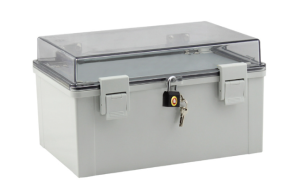
IP Rating vs. NEMA Rating
IP and NEMA ratings are both used to describe enclosure protection, but they are not simply interchangeable labels.
The IP Code is defined under IEC 60529 and uses digits to describe protection against solids and water ingress.
NEMA enclosure types use a different classification system and address additional environmental characteristics depending on the type.
For a project, we recommend specifying the actual required standard and rating, rather than simply asking for a "waterproof box."
For example:
- IP65
- IP66
- IP67
- NEMA 3R
- NEMA 4
- NEMA 4X
may represent very different requirements.
The right choice should come from the installation environment and project specification.
Does "Outdoor" Automatically Mean IP66 or NEMA 4X?
No.
This is another assumption we frequently see.
An outdoor installation could mean a protected location under a roof.
It could also mean:
- Direct rain
- Strong sunlight
- Wind-driven dust
- Water spray
- Coastal salt exposure
- Industrial chemicals
- Frequent washdown
Those are very different environments.
So instead of asking: "Is it for outdoor use?"
we prefer to ask: "What will the enclosure actually be exposed to?"
That gives engineering a much more useful starting point.
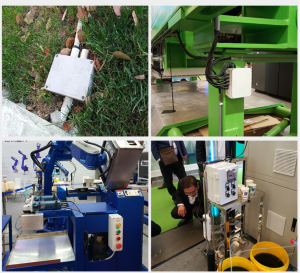
Plastic or Metal: Which Junction Box Is Better?
There isn't one material that is always better.
The correct material depends on the application.
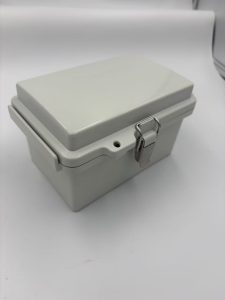
Plastic Junction Boxes
Common materials include:
- ABS
- Polycarbonate (PC)
- Polypropylene (PP)
- GRP/FRP
Plastic may be a good choice when the project prioritizes:
- Low weight
- Corrosion resistance
- Electrical insulation
- Cost efficiency
- Easy molding into complex shapes
But "plastic" is not a complete material specification.
For an enclosure exposed to direct sunlight for years, we would want to confirm the actual resin grade and weathering requirements rather than assuming that every plastic enclosure is equally suitable outdoors.
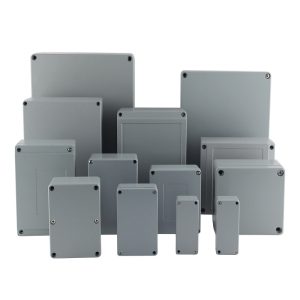
Metal Junction Boxes
Common materials include:
- Mild steel
- Galvanized steel
- Aluminum
- 304 stainless steel
- 316/316L stainless steel
Metal may be preferable where the application requires greater mechanical strength or specific grounding, bonding or shielding characteristics.
Stainless steel may also be appropriate in corrosive environments.
But we don't recommend automatically choosing 316L simply because the enclosure is outdoors.
A better question is: What is causing the corrosion risk?
For example:
- Coastal salt exposure
- Chemical exposure
- Frequent washdown
- High humidity
- Food-processing environments
can lead to very different material decisions.
Why Cable Entry Location Matters
Cable entry location can affect the enclosure more than customers initially expect.
We normally review:
- Number of cable entries
- Cable diameter
- Gland size
- Thread specification
- Hole diameter
- Hole spacing
- Distance from the enclosure edge
- Internal cable routing
For example, several glands may fit dimensionally on one side of the box but leave insufficient room for the gland nuts inside.
Or the glands may be correctly spaced but force cables directly across a terminal block.
This is why we prefer to finalize the cable-entry layout together with the internal component layout.
The hole pattern should follow the wiring strategy—not simply the available flat surface.
Mounting Points Are Part of the Enclosure Design
Mounting holes are often treated as a simple drawing detail.
They shouldn't be.
For a custom enclosure, mounting points can affect:
- Wall thickness
- Internal bosses
- Screw access
- Component placement
- Structural strength
- Tooling
- Assembly sequence
For example, moving a mounting hole by a few millimeters may solve an external installation problem but create interference with an internal PCB or terminal block.
That's why we review external mounting and internal component mounting at the same time.
What About Hinges and Fasteners?
For hinged junction boxes, the hinge is part of the mechanical system—not just hardware attached to the outside.
We consider:
- Hinge location
- Opening direction
- Cover clearance
- Opening angle
- Hinge material
- Pin design
- Fastener position
- Interference with internal components
The same applies to screws, clips and latches.
A fastening system needs to provide enough compression to close the enclosure properly without creating unnecessary stress or distortion.
This becomes particularly important when the cover also needs to compress a gasket.
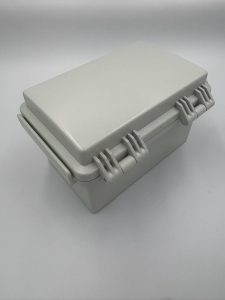
Junction Box Design Starts to Change When the Enclosure Is Shallow
Depth is often underestimated.
A shallow enclosure can be much more challenging than a deeper enclosure with the same length and width.
Why?
Because several requirements are competing for the same small amount of vertical space:
Wall thickness-Internal mounting features-Components-Cable routing-Cover structure-Gasket-Assembly clearance
For this reason, a shallow enclosure should be reviewed from a cross-sectional perspective, not just from the top view.
This is one of the situations where a simple external dimension check isn't enough.
What We Check Before Manufacturing a Custom Junction Box
When we receive a custom junction box drawing, our review normally follows a practical sequence.
1. Overall dimensions
We confirm the required length, width and height/depth.
2. Internal components
We identify the actual parts that need to fit inside.
3. Usable internal space
We check clearance around components, mounting features and wiring.
4. Cable entries
We review the number, size, location and spacing of cable entries.
5. Mounting
We check external mounting points and internal component mounting.
6. Sealing
We review the cover interface, gasket arrangement and fastening structure.
7. Material
We consider mechanical requirements and the actual environmental exposure.
8. Manufacturing process
For injection-molded plastic parts, we review features such as:
- Wall thickness
- Draft
- Ribs
- Bosses
- Undercuts
- Parting lines
- Ejection
- Tooling complexity
9. Production quantity
A prototype and a 10,000-piece production run may require completely different manufacturing strategies.
This is why we don't separate engineering from production planning.
The enclosure has to make sense both as a product and as a manufacturable part.
8 Common Junction Box Mistakes We See
Mistake 1: Specifying only the outside dimensions
The box may look large enough, but the actual assembly doesn't fit comfortably.
Mistake 2: Saying "waterproof"
Waterproof is not a precise engineering requirement.
Specify the required IP or NEMA rating and installation environment.
Mistake 3: Choosing the cable glands afterward
Cable entries can affect wall space, internal clearance and sealing.
Mistake 4: Ignoring cable bending
A gland fitting through the wall doesn't mean the cable can be routed properly inside.
Mistake 5: Treating the gasket as an accessory
The sealing interface needs to be designed into the enclosure.
Mistake 6: Putting mounting features wherever there is available space
External mounting features can interfere with internal components.
Mistake 7: Choosing material based only on price
The cheapest material isn't necessarily the lowest-cost solution over the product's service life.
Mistake 8: Releasing tooling before the design is fully reviewed
For injection molding, correcting a design after tooling begins can be significantly more expensive than solving the problem during the design stage.
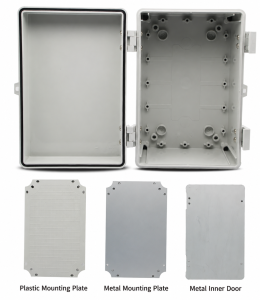
What Information Should You Send a Junction Box Manufacturer?
If you're requesting a quotation for a custom junction box, the more useful information is not necessarily a longer specification sheet.
We would ideally want:
Enclosure dimensions
Length × width × height/depth.
Internal components
Component drawings, models or at least accurate dimensions.
Cable information
- Cable quantity
- Cable diameter
- Gland size
- Thread type
- Entry locations
Protection requirement
Specify:
- IP rating
- NEMA type
- Applicable project standard
Material
For example:
- ABS
- PC
- Aluminum
- 304 stainless steel
- 316L stainless steel
- GRP/FRP
Mounting requirements
Tell us whether the enclosure needs:
- Wall mounting
- Panel mounting
- DIN rail
- Internal bosses
- Custom brackets
Environment
Include relevant conditions such as:
- Indoor/outdoor
- UV exposure
- Rain
- Dust
- Salt spray
- Chemicals
- Temperature
- Washdown
Quantity
Prototype quantity and annual production volume can influence the most economical manufacturing process.
When Should You Use a Standard Junction Box?
A standard product is often the best option when:
- The dimensions are suitable
- The internal components fit
- Cable entries are compatible
- The required protection level is available
- No special mounting features are needed
- Production quantity doesn't justify custom tooling
There is no benefit in custom tooling simply for the sake of having a custom box.
If a standard enclosure meets the application, it may be the more efficient solution.
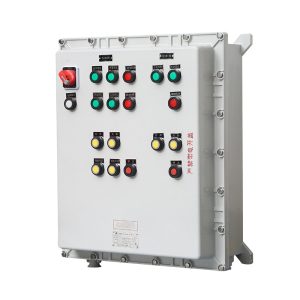
When Does a Custom Junction Box Make More Sense?
Custom design becomes more attractive when standard products create compromises.
For example:
- The required dimensions are unusual
- The enclosure must fit a specific PCB
- Cable entries need to be in specific locations
- Internal bosses are required
- A special gasket profile is needed
- The enclosure needs a particular hinge arrangement
- Branding or custom appearance is important
- A high annual production volume justifies tooling
This is where enclosure engineering can create real value.
Instead of forcing the electronics into an existing box, the enclosure can be designed around the product.
The Manufacturing Process Matters Too
Not every custom junction box should automatically be injection molded.
For early prototypes or very low quantities, options such as:
- CNC machining
- 3D printing
- Sheet metal fabrication
- Silicone molding
may make more sense depending on the geometry and requirements.
For larger production volumes, injection molding can become more attractive for suitable plastic enclosure designs because the tooling cost can be spread across a larger quantity.
The right process depends on: Geometry + material + quantity + tolerance + tooling budget + production schedule
This is why we normally want to know the expected quantity before recommending a manufacturing route.
The Question We Ask First
When someone sends us a drawing and says: "We need a junction box."
we could immediately ask for: Length × width × height.
But that isn't always the most useful first question.
We would rather ask: "What are you putting inside it?"
Once we understand the internal assembly, we can start working backward:
What needs to fit → how it will be mounted → how the cables will enter → how the cables will be routed → how the cover will seal → what environment it will face → how it should be manufactured.
That sequence usually produces a much more useful enclosure specification.
Final Thoughts
A junction box may look like one of the simplest products in an electrical system.
But the box itself is only part of the solution.
The real design challenge is making the enclosure work with everything around it: components, terminals, cables, glands, gasket, fasteners, mounting points and the installation environment.
From a manufacturing perspective, we don't believe the best junction box is simply the one with the largest internal volume or the highest protection rating.
It is the one that provides the right amount of usable space, appropriate environmental protection, practical cable routing, reliable sealing and manufacturable construction for the actual application.
That's why our preferred starting point is simple: Start with the connection, not the box.
Once we understand what needs to be connected and how it needs to be installed, the enclosure dimensions, material, sealing structure and manufacturing process become much easier to define.
Contact us: vivian@hofeng.com