




Custom Plastic Enclosures for Wearable Electronics and AI Devices
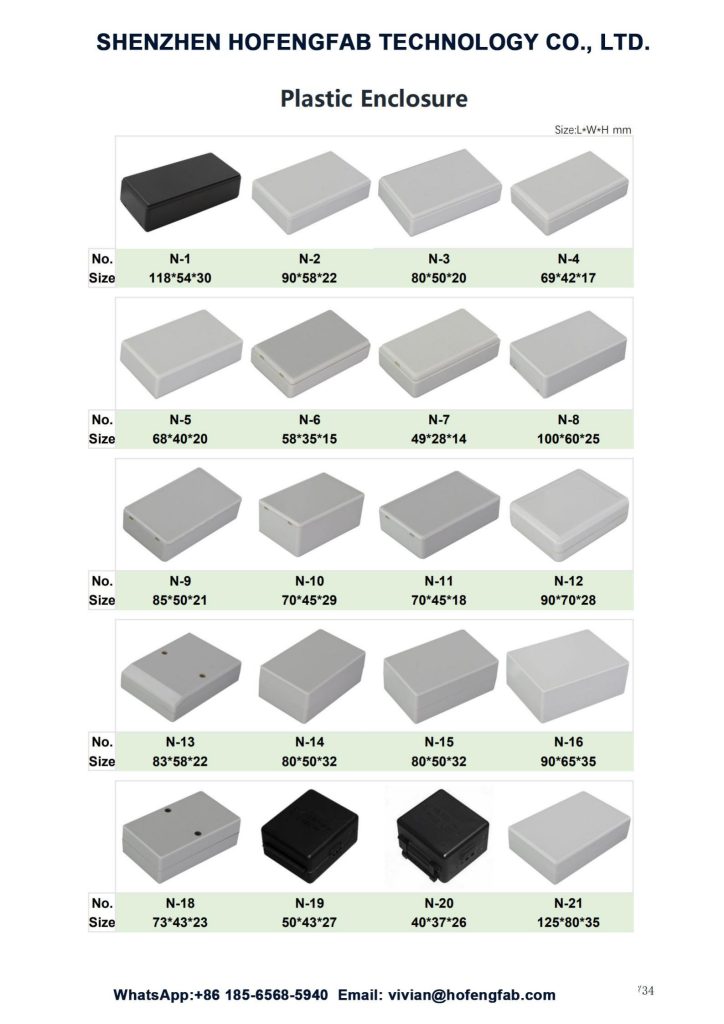
Wearable electronics often require custom plastic enclosures that support compact internal layouts, environmental sealing, mechanical durability, and manufacturability at scale. For products integrating cameras, batteries, wireless modules, and AI functions, enclosure design becomes a key part of system reliability.
Core Materials: ABS, PC, and ABS/PC
Injection-molded ABS and PC are commonly applied in wearable devices due to:
Structural rigidity
Impact resistance
Lightweight characteristics
Process compatibility
Surface texture flexibility
ABS/PC blends provide higher dimensional stability and improved toughness—useful for clip mechanisms, fastening interfaces, and magnetic mounts.
Typical molded wall thickness: 1.2–2.0 mm
Standard tolerance: ±0.1–0.3 mm (geometry and mold-dependent)
Ingress Protection: IP54 Requirements
Wearable use cases typically specify IP54 for splash and dust protection. Achieving IP54 involves:
Controlled parting lines
Gasket sealing or compression ribs
Flatness for sealing interfaces
Defined ingress paths
Material compatibility with humidity and sweat exposure
For higher environmental requirements (IP65–IP67), enclosure sealing complexity and cost will increase accordingly.
Mechanical Interfaces for Wearability
Body-worn cameras and similar devices often incorporate:
Clip mounting
Magnetic mounts
Docking interfaces
Adhesive pads
Mechanical latches
Cyclic mechanical loading requires materials with sufficient toughness; PC and ABS/PC blends typically outperform pure ABS in fatigue applications.
Internal Layout and DFM Constraints
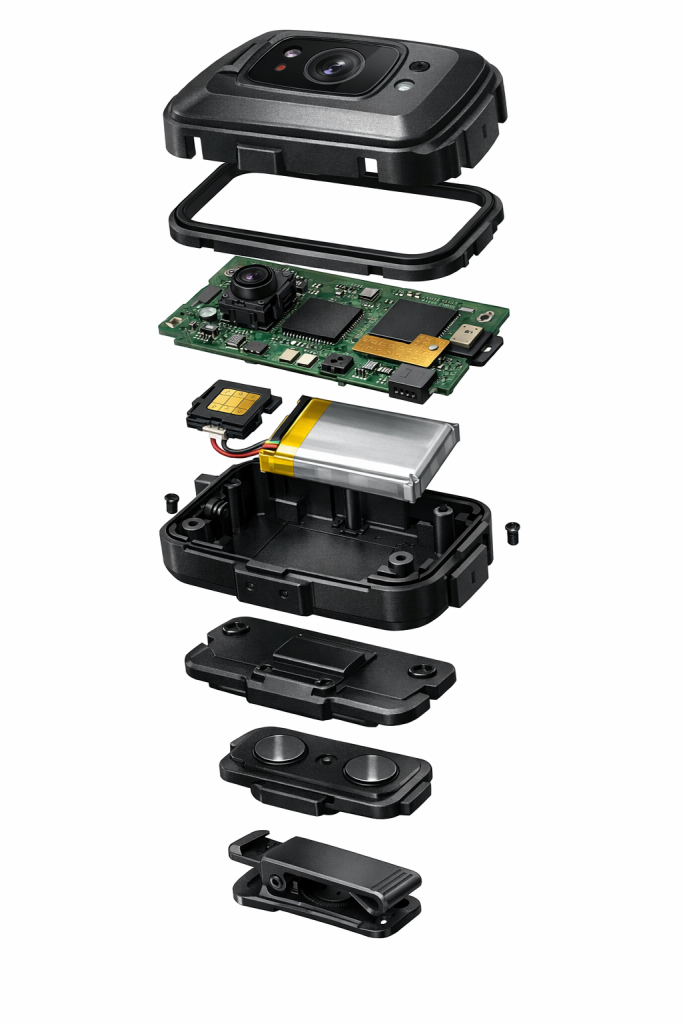
Wearable enclosures require compact integration of:
Camera module
Battery pack
PCB
SIM card
Wireless components (antenna clearance required)
AI/ML processing chips
DFM considerations include assembly sequence, fastening strategy, draft angles, release paths, and surface finish requirements.
1. Production Workflow
A standard enclosure development process consists of four steps:
2. Industrial Design + 3D Modeling
Defines geometry, internal layout, and sealing strategy.
3. Mold Cost Estimation
Cost depends on mold steel grade, cavity count, texture, and production volume.
4. Prototyping (5–10 units)
Used for fit validation, IP testing, ergonomics, and mechanical evaluation.
5. Mass Production
Includes MOQ, QC inspection criteria, cycle time, and scaling strategy.
Cost Structure (Engineering View)
- Major cost drivers include:
- Mold complexity
- Material selection
- Surface texture and finishing
- Production volume
- Assembly labor
- Reliability requirements
Mass production pricing cannot be estimated accurately before Step 1 is finalized.
Application Case: Wearable AI Body Camera
Typical system configuration includes:
- Camera + optics
- Battery + power management
- Cellular + SIM card
- Wireless antennas
- AI/ML compute + cloud interface
Environmental requirement: IP54
Functional requirement: Clip or magnetic mount
Thermal requirement: Processors + batteries require dissipation path
Engineering fields involved:
Mechanical design
Electronics integration
Antenna/EMI engineering
Reliability testing
Manufacturing & QC